15 Daily Challenges Schools Face—and How Technology Solves Them
Managing a school involves much more than delivering quality education. Every day, administrators, principals, teachers, and support staff handle numerous…
A Practical Guide to Overcoming School Management Challenges with Digital Solutions
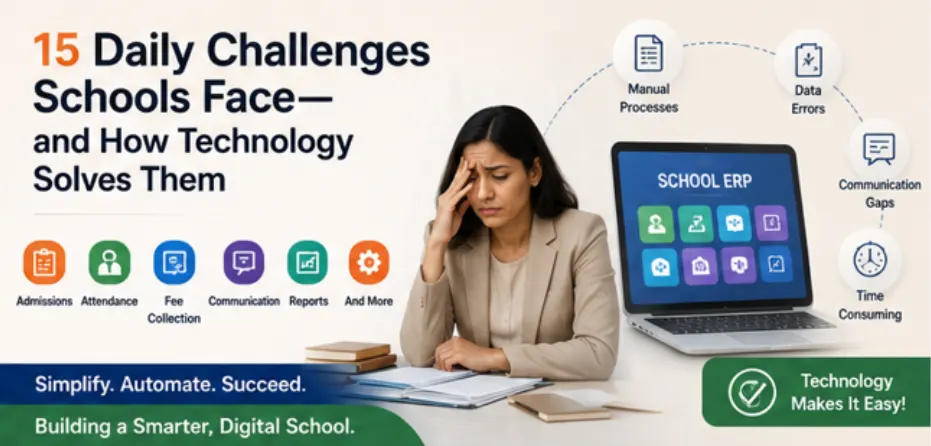
Managing a school involves much more than delivering quality education. Every day, administrators, principals, teachers, and support staff handle numerous responsibilities—from admissions and attendance to fee collection, parent communication, examinations, and reporting. As student enrollment grows, these daily tasks become increasingly complex and time-consuming.
Many schools still rely on manual processes, paper records, and spreadsheets. While these methods may work for smaller institutions, they often create inefficiencies, communication gaps, and administrative errors as schools expand.
This is where modern technology makes a significant difference. A School ERP and other School Automation tools help educational institutions simplify operations, improve collaboration, and create a more efficient Digital School environment.
In this article, we’ll explore 15 common School Management Challenges and how technology provides practical solutions.
Why School Management Is Becoming More Complex
Today’s schools are expected to provide:
 Better academic outcomes
- Transparent communication
- Faster administrative services
- Secure data management
- Digital access for parents and students
- Efficient financial operations
Meeting these expectations using traditional methods is becoming increasingly difficult.
Technology enables schools to handle these responsibilities more effectively while improving the overall educational experience.
Managing Student Admissions
The Challenge
Paper-based admissions often involve lengthy forms, misplaced documents, and slow processing.
A School ERP offers:
- Online admission forms
- Digital document uploads
- Application tracking
- Automated admission workflows
Admissions become faster, more organized, and more convenient for parents.
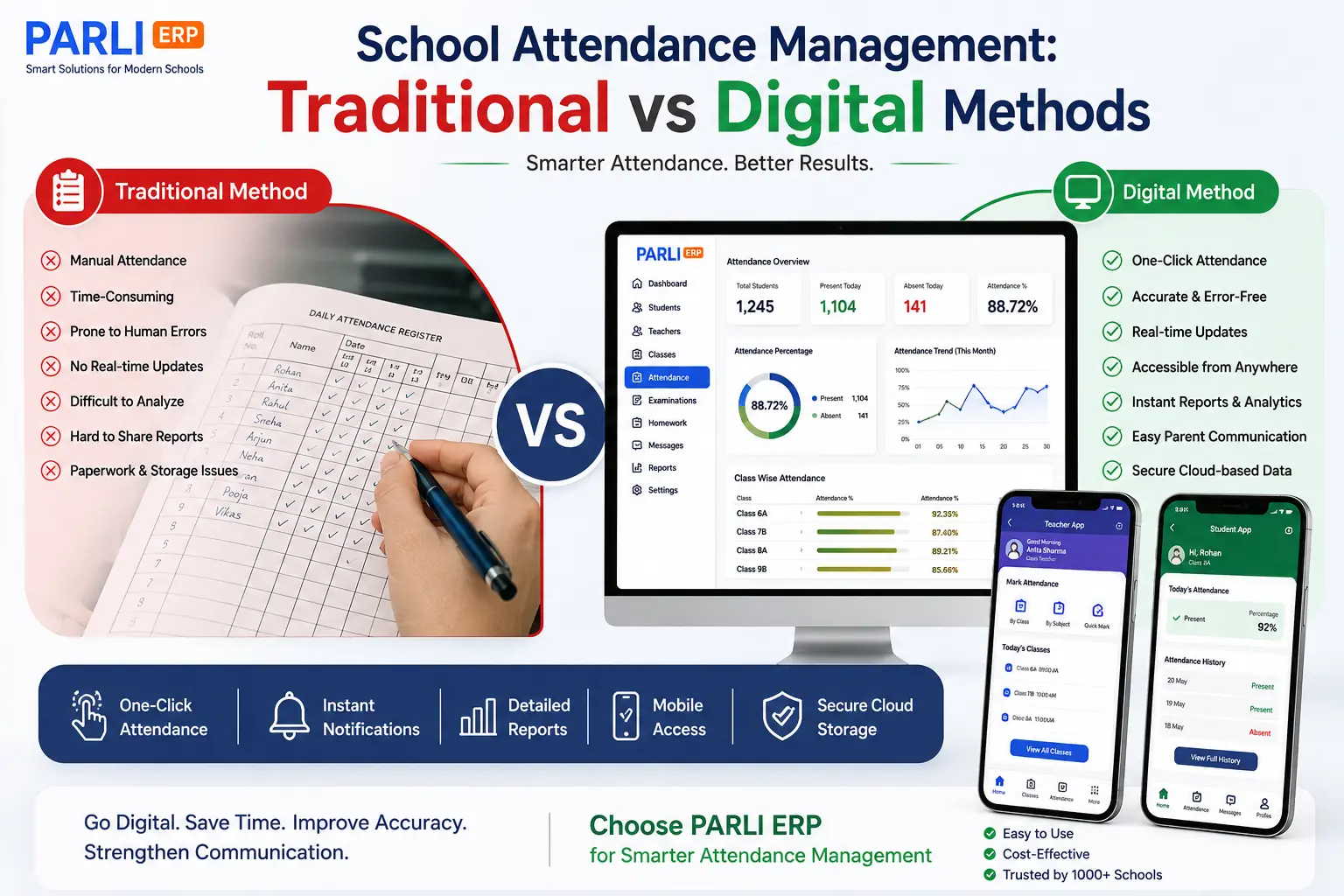
Recording Daily Attendance
The Challenge
Manual attendance registers consume classroom time and increase the risk of errors.
Digital attendance systems allow teachers to:
- Mark attendance quickly
- Generate attendance reports
- Track absenteeism
- Share updates with parents
Attendance becomes more accurate and easier to manage.
Managing Student Records
The Challenge
Student information stored in multiple files or spreadsheets is difficult to update and retrieve.
A centralized student database provides instant access to:
- Personal details
- Academic records
- Attendance history
- Fee information
- Parent contacts
Everything is available from one secure platform.
Smarter Parent Communication
Strong communication between schools and parents contributes to student success.
AI-powered communication tools can assist schools by:
- Sending automated reminders
- Delivering attendance notifications
- Sharing academic updates
- Answering common parent questions through chatbots
- Scheduling important announcements
This improves responsiveness while reducing administrative workload.
AI-Powered Virtual Assistants
Many educational institutions are introducing AI assistants to support students, parents, and staff.
Virtual assistants can help answer questions about:
- Admission procedures
- School timings
- Examination schedules
- Fee information
- Event details
- Frequently asked questions
Providing instant responses improves the user experience and saves valuable staff time.
Smarter Decision-Making with Data Analytics
Schools collect large amounts of information every day.
AI-powered analytics help administrators make informed decisions by analyzing:
- Student enrollment trends
- Attendance reports
- Academic performance
- Resource utilization
- Financial data
These insights support better planning and long-term institutional growth.
Enhanced School Security
Artificial Intelligence can contribute to safer school environments through intelligent monitoring systems.
Potential applications include:
- Visitor management
- Smart surveillance alerts
- Access control monitoring
- Emergency response support
- Security analytics
While human oversight remains essential, AI can improve response times and enhance campus safety.
Supporting Teachers Instead of Replacing Them
One of the biggest misconceptions about AI is that it will replace teachers.
In reality, AI is designed to assist educators by handling repetitive administrative tasks and providing valuable insights.
Teachers can use AI to:
- Create lesson plans more efficiently
- Analyze student performance
- Generate quizzes and practice questions
- Organize classroom resources
- Save time on routine administrative work
This allows educators to spend more time teaching, mentoring, and inspiring students.
Benefits of AI in Education
Schools adopting AI technologies often experience significant improvements.
Improved Learning Experiences
Students receive more personalized educational support.
Greater Administrative Efficiency
Automation reduces repetitive manual work.
Better Student Engagement
Interactive and adaptive learning tools encourage participation.
Data-Driven Decisions
Administrators gain valuable insights through advanced analytics.
Stronger Parent Engagement
AI-powered communication improves transparency and responsiveness.
Increased Productivity
Teachers and administrators spend more time on meaningful educational activities.
Common Myths About AI in Schools
Myth 1: AI Will Replace Teachers
Reality: AI supports teachers by automating repetitive tasks and providing helpful insights.
Myth 2: AI Is Only for Large Schools
Reality: Schools of all sizes can benefit from AI-powered tools.
Myth 3: AI Is Too Complicated
Reality: Modern EdTech solutions are designed with user-friendly interfaces that make adoption easier.
Myth 4: AI Eliminates Human Interaction
Myth 4: AI Eliminates Human Interaction
Common Myths About AI in Schools
Myth 1: AI Will Replace Teachers
Reality: AI supports teachers by automating repetitive tasks and providing helpful insights.
Myth 2: AI Is Only for Large Schools
Reality: Schools of all sizes can benefit from AI-powered tools.
Myth 3: AI Is Too Complicated
Reality: Modern EdTech solutions are designed with user-friendly interfaces that make adoption easier.
Myth 4: AI Eliminates Human Interaction
Myth 4: AI Eliminates Human Interaction
How Schools Can Prepare for AI Adoption
Schools planning to implement AI should consider the following:
- Strengthen digital infrastructure.
- Train teachers and administrative staff.
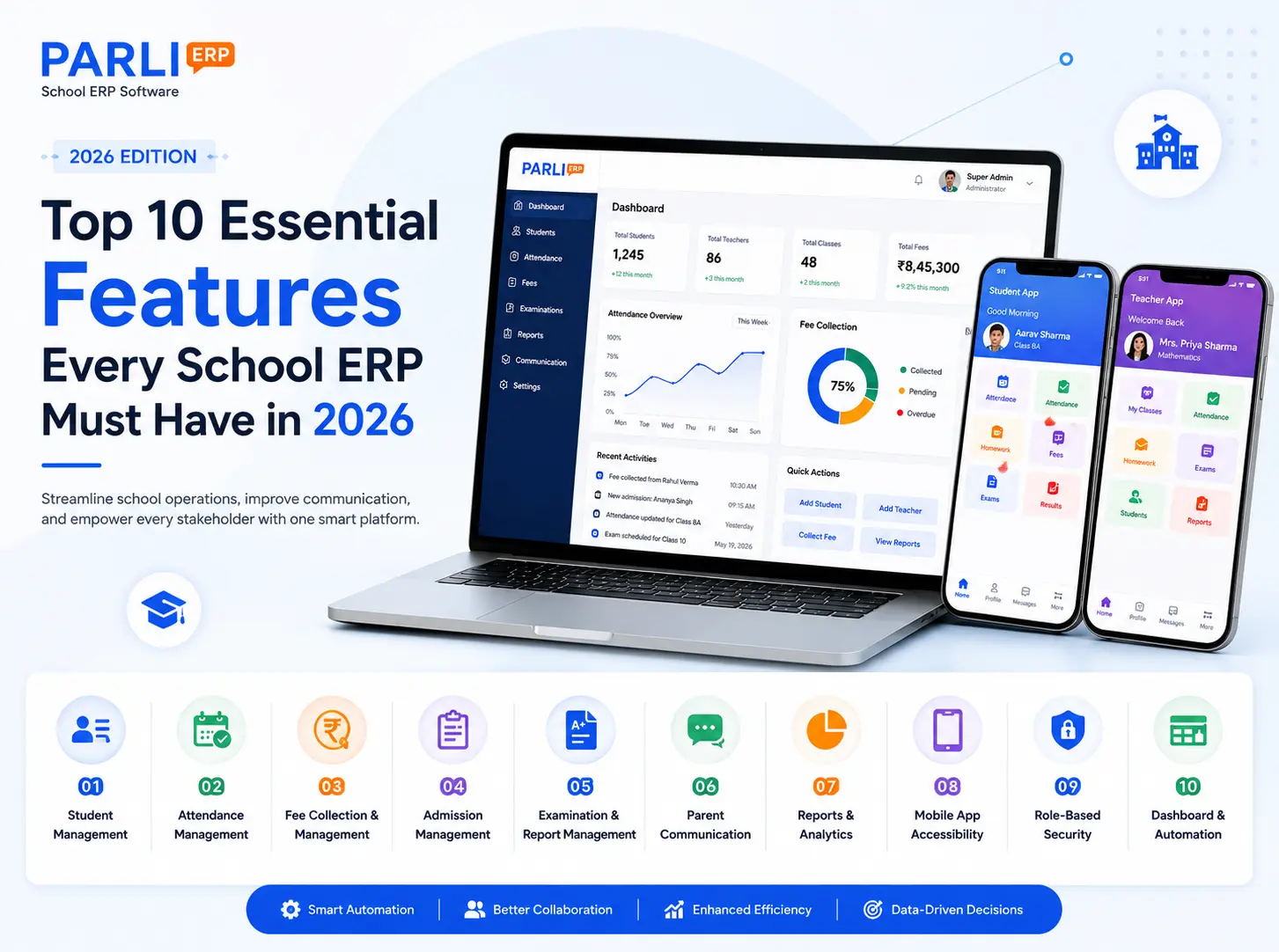
- Invest in modern School ERP systems.
- Protect student data with strong security measures.
- Introduce AI gradually through practical use cases.
- Evaluate technology based on educational goals.
A thoughtful implementation strategy ensures successful adoption.
The Future of Smart Education
As technology continues to evolve, AI will play an increasingly important role in education.
Future developments may include:
- More advanced personalized learning
- Predictive student success analysis
- Intelligent classroom management
- Enhanced accessibility tools
- Improved collaboration between schools and families
- Smarter administrative automation
The schools that embrace Smart Education today will be better prepared to meet tomorrow’s educational challenges.
Conclusion
Artificial Intelligence is transforming education by making schools more efficient, connected, and student-focused. From personalized learning and automated administration to intelligent analytics and improved parent communication, AI in Education offers practical benefits for institutions of every size.
Rather than replacing educators, Artificial Intelligence for Schools empowers teachers and administrators to work more effectively while improving the overall learning experience. Combined with modern EdTech solutions and digital school management systems, AI is helping build smarter, more innovative schools.
As education continues to evolve in 2026 and beyond, schools that embrace AI responsibly will be better positioned to deliver high-quality learning, improve operational efficiency, and prepare students for a technology-driven future.
Ready to simplify school management?
See how PARLI school ERP software helps schools automate attendance, fees, homework, and parent communication from one platform.