How to Improve Fee Collection with an Integrated School ERP System
Managing school fees is one of the most important responsibilities of any educational institution. Timely fee collection ensures smooth day-to-day…
A Complete Guide to Smarter School Fee Management in 2026
Managing school fees is one of the most important responsibilities of any educational institution. Timely fee collection ensures smooth day-to-day operations, supports staff salaries, maintains infrastructure, and funds academic activities. However, many schools still rely on manual processes, spreadsheets, or disconnected systems that often result in delayed payments, calculation errors, and additional administrative work.
As schools embrace digital transformation, an integrated School ERP has become an effective solution for simplifying School Fee Management. By automating fee collection, improving financial transparency, and providing parents with convenient payment options, schools can reduce administrative burdens while improving the overall payment experience.
In this guide, we’ll explore how a School ERP improves fee management, the benefits of Online Fee Collection, and the key features every school should look for in modern Fee Management Software.
What Is School Fee Management?
School Fee Management refers to the process of creating fee structures, collecting payments, tracking outstanding balances, generating receipts, and maintaining financial records for students.
An effective fee management process helps schools:
 Collect fees on time
- Maintain accurate financial records
- Reduce payment errors
- Improve communication with parents
- Support transparent financial operations
When managed digitally through a School ERP, the entire process becomes faster, more accurate, and easier to monitor.
Challenges of Manual Fee Collection
Many schools continue to manage fees using paper records or spreadsheets. While this approach may work for smaller institutions, it often becomes inefficient as student enrollment increases.
Common challenges include:
- Manual fee calculations
- Lost or incomplete payment records
- Delayed fee reminders
- Long queues during payment days
- Time-consuming receipt generation
- Difficulty tracking outstanding dues
- Increased risk of human error
These issues consume valuable administrative time and can affect the school’s financial planning.
What Is an Integrated School ERP?
A School ERP is a centralized platform that manages both academic and administrative functions. When fee management is integrated with other school operations, information flows automatically between departments.
For example:
- Student admission details are linked to fee records.
- Payment status is updated in real time.
- Parents receive automatic fee reminders.
- School accounts remain synchronized with financial reports.
This integration eliminates duplicate data entry and improves operational efficiency.
How a School ERP Improves Fee Collection
Automated Fee Structure Management
Schools often have different fee structures based on grade level, transportation, hostel facilities, or optional services.
A School ERP allows administrators to:
- Create customized fee structures
- Assign fees to student groups
- Update fee categories easily
- Apply discounts or scholarships where applicable
Automation reduces manual calculations and improves consistency.
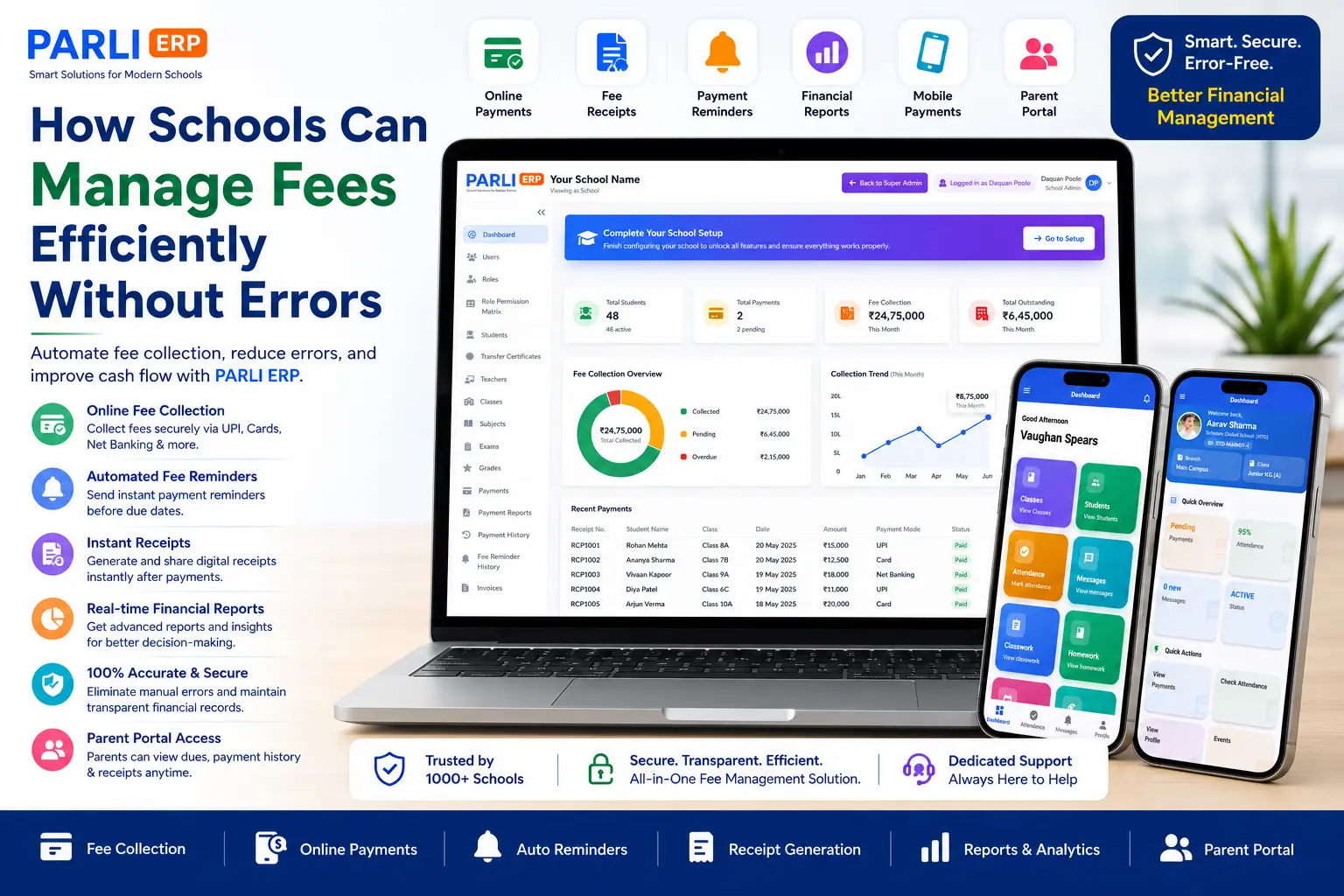
Convenient Online Fee Collection
Parents increasingly prefer digital payment options that allow them to pay fees securely without visiting the school.
With Online Fee Collection, parents can:
- Pay anytime and from anywhere
- Use multiple payment methods
- Receive instant payment confirmation
- Access payment history
Digital payments improve convenience while reducing administrative workload.
Automatic Fee Reminders
Late payments are often caused by missed deadlines rather than intentional delays.
An integrated ERP can automatically send reminders before due dates through:
- Mobile notifications
- Email alerts
- SMS notifications (if enabled)
- Parent mobile apps
Timely reminders encourage prompt payments and reduce outstanding balances.
Instant Receipt Generation
Manual receipt preparation takes time and increases the possibility of errors.
A School ERP automatically generates digital receipts after successful payment, providing:
- Payment confirmation
- Transaction details
- Downloadable records
- Easy access for parents and administrators
This improves transparency and simplifies record keeping.
Real-Time Payment Tracking
Administrators can monitor fee collection as payments are received.
The system provides visibility into:
- Paid fees
- Pending payments
- Partial payments
- Overdue accounts
Real-time tracking allows schools to take timely follow-up actions when necessary.
Improved School Accounting
An integrated ERP simplifies School Accounting by automatically recording financial transactions.
Benefits include:
- Accurate financial records
- Reduced manual bookkeeping
- Better audit readiness
- Simplified reconciliation
- Improved financial reporting
This helps schools maintain organized and transparent financial operations.
Comprehensive Financial Reports
School leaders need accurate reports to make informed financial decisions.
A School ERP can generate reports such as:
- Daily fee collection
- Monthly revenue summaries
- Outstanding dues
- Payment trends
- Class-wise fee reports
- Scholarship reports
Instant access to financial insights supports better planning and budgeting.
Better Parent Experience
Parents appreciate transparent and convenient payment processes.
A School ERP allows parents to:
- View fee details
- Check payment history
- Download receipts
- Receive payment reminders
- Track outstanding balances
A positive payment experience strengthens parent satisfaction and trust.
Reduced Administrative Work
Fee collection involves repetitive tasks that consume significant staff time.
Automation reduces the need for:
- Manual calculations
- Paper receipts
- Data entry
- Follow-up phone calls
- Spreadsheet updates
Administrative teams can focus on higher-value responsibilities instead of routine paperwork.
Enhanced Data Security
Financial information requires strong protection.
Modern Fee Management Software includes features such as:
- Secure login
- Role-based access
- Data encryption
- Cloud backups
- Audit logs
These measures help protect sensitive financial and student information.
Essential Features to Look for in Fee Management Software
When choosing a School ERP, ensure the fee management module includes:
- Flexible fee structures
- Online payment gateway integration
- Automated reminders
- Digital receipt generation
- Outstanding fee tracking
- Financial reporting
- Parent portal
- School accounting integration
- Mobile accessibility
- Secure cloud storage
These features improve both operational efficiency and the parent experience.
Best Practices to Improve Fee Collection
Schools can further increase collection efficiency by following these best practices:
- Offer convenient online payment options.
- Send automated reminders before due dates.
- Provide transparent fee statements.
- Keep payment records updated in real time.
- Enable parents to access fee details through a mobile app.
- Review collection reports regularly.
- Integrate fee management with school accounting.
Combining technology with clear communication helps improve payment compliance.
Why Digital Fee Management Matters in 2026
As educational institutions continue to modernize, parents expect the same convenience from schools that they receive from online banking and digital commerce.
Digital fee management helps schools:
- Improve cash flow
- Reduce administrative costs
- Enhance parent satisfaction
- Increase financial transparency
- Simplify accounting processes
- Support long-term institutional growth
Schools adopting digital financial systems are better equipped to manage growing operational demands.
Conclusion
Efficient School Fee Management is essential for maintaining a school’s financial health and delivering uninterrupted educational services. Manual processes often create unnecessary delays, administrative burdens, and payment errors that affect both schools and parents.
By implementing an integrated School ERP with advanced Online Fee Collection, School Accounting, and Fee Management Software capabilities, schools can automate financial operations, improve transparency, reduce paperwork, and provide a smoother payment experience.
As schools continue embracing digital transformation, investing in a modern fee management solution is a practical step toward improving operational efficiency, strengthening parent trust, and ensuring long-term financial sustainability.
Ready to simplify school management?
See how PARLI school ERP software helps schools automate attendance, fees, homework, and parent communication from one platform.