Why Every School Needs an ERP System in 2026: A Complete Guide
Schools today manage admissions, attendance, fees, examinations, communication, homework, transport, and academic records every day. School ERP Software…
How School ERP Software Is Transforming Modern Education
Schools today manage admissions, attendance, fees, examinations, communication, homework, transport, and academic records every day. School ERP Software helps automate these tasks through one centralized platform, improving efficiency, accuracy, and communication for administrators, teachers, students, and parents.
Traditional methods such as paper registers, spreadsheets, and disconnected software often lead to delays, human errors, and communication gaps. As schools continue to embrace digital transformation, investing in a School ERP system has become a necessity rather than a luxury.
In this guide, you’ll learn what a School ERP is, why it has become essential in 2026, its key benefits, must-have features, and how it helps schools improve efficiency while delivering a better experience for students, parents, teachers, and administrators.
What Is School ERP Software?
A School ERP (Enterprise Resource Planning) system is an integrated software solution that helps educational institutions manage academic and administrative operations through a single centralized platform.
Instead of maintaining multiple registers, Excel sheets, and separate software applications, a School ERP allows schools to manage everything in one place.
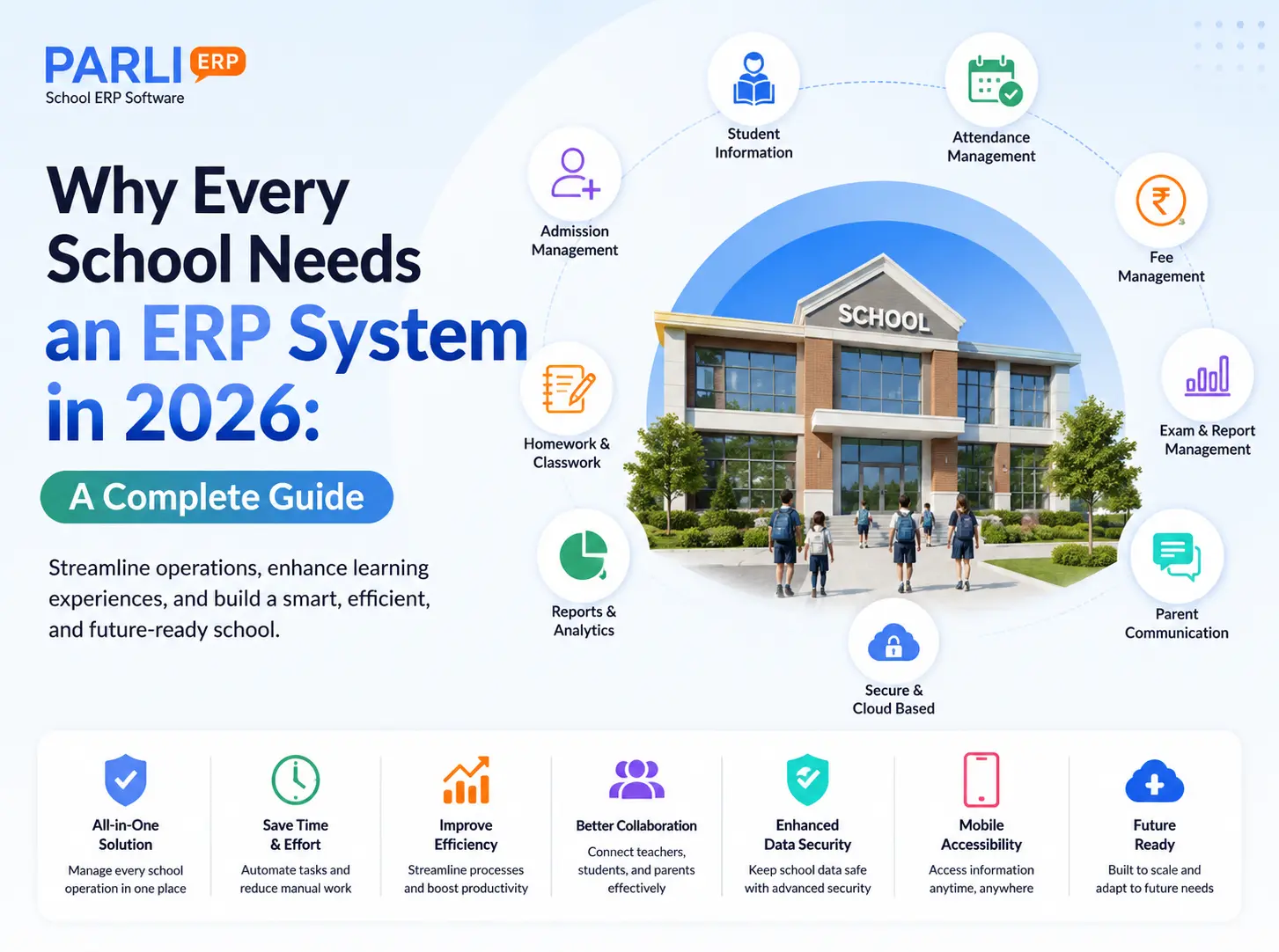
A modern School ERP typically includes modules for:
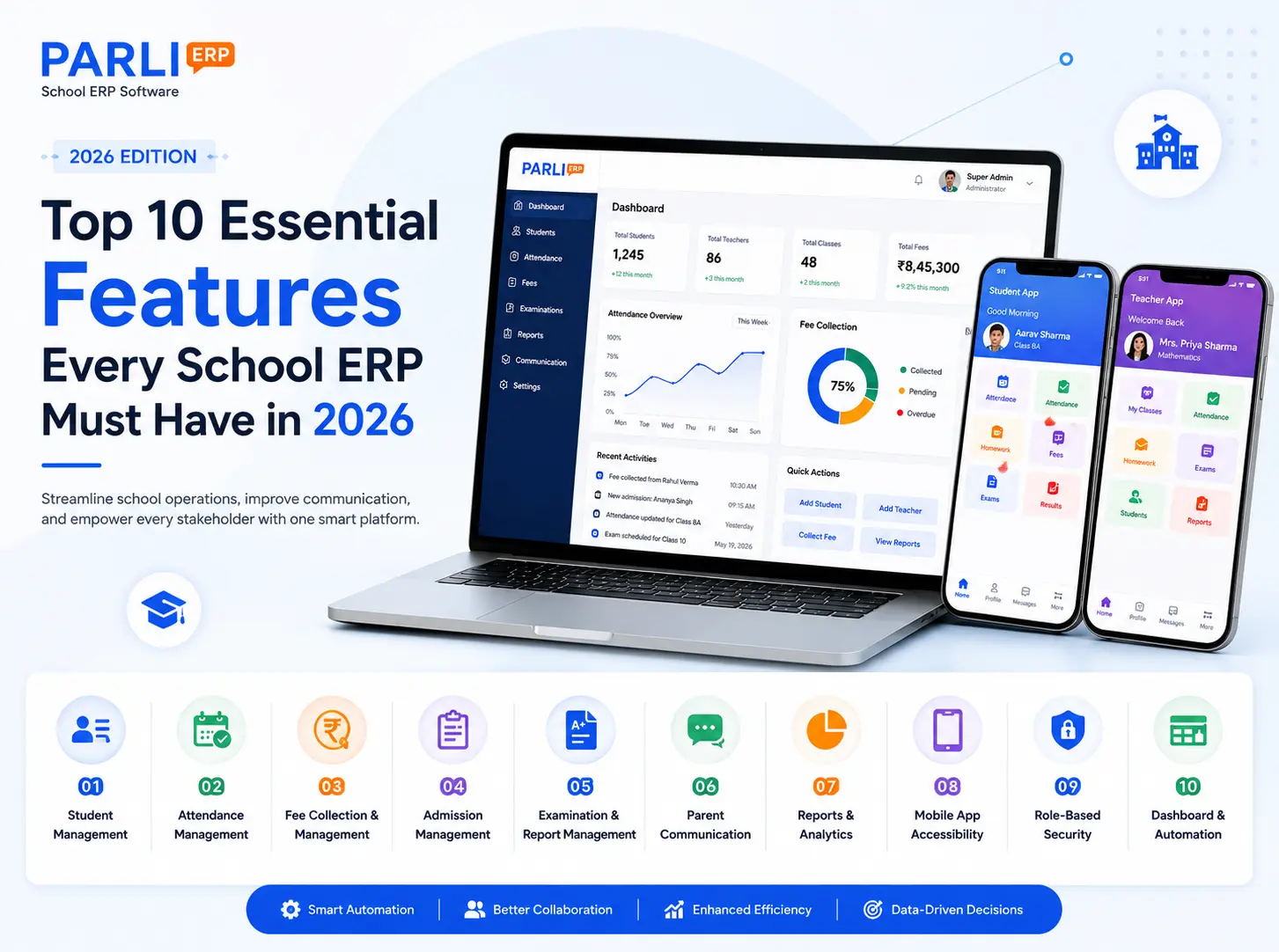
 Student Information Management
- Attendance Management
- Admission Management
- Fee Management
- Examination Management
- Homework & Classwork
- Parent Communication
- Reports & Analytics
By connecting different departments, a School ERP ensures that information is accurate, up-to-date, and easily accessible.
Why Schools Need School ERP Software in 2026
Education is becoming more technology-driven every year. Parents expect instant communication, teachers need tools that reduce paperwork, and administrators require real-time insights to make informed decisions.
Schools that continue relying on manual processes often face challenges such as:
- Attendance records maintained in spreadsheets
- Time-consuming administrative work
- Delayed fee tracking
- Communication gaps with parents
- Manual report generation
- Scattered student records
- Increased chances of human error
A School ERP helps eliminate these challenges by automating repetitive tasks and centralizing school operations.
Simplified School Administration
Administrative teams spend countless hours managing student records, admissions, attendance, and reports.
Key Advantages
- Reduced manual work
- Faster processing
- Improved productivity
- Better operational efficiency
Centralized Student Information Management
Managing student records across multiple files can create confusion and errors.
A School ERP stores all student-related information in one secure location, including:
- Personal details
- Academic records
- Attendance history
- Fee details
This makes retrieving and updating information quick and hassle-free.
Digital Attendance Management
Attendance is one of the most important daily activities in every school.
With a School ERP, teachers can:
- Mark attendance digitally
- Generate attendance reports
- Track absenteeism
- Share attendance updates with parents
This improves accuracy while saving valuable classroom time.
Online Fee Management
Fee collection becomes much easier with an automated system.
A School ERP enables schools to:
- Create fee structures
- Track payments
- Send payment reminders
- Generate receipts
- Monitor outstanding dues
Digital fee management reduces errors and improves financial transparency.
Streamlined Admission Management
Admissions often involve extensive paperwork and manual verification.
With a School ERP, schools can simplify admissions by:
- Managing applicant records
- Accepting online applications
- Tracking admission status
- Maintaining digital documentation
This creates a smoother experience for both parents and administrators.
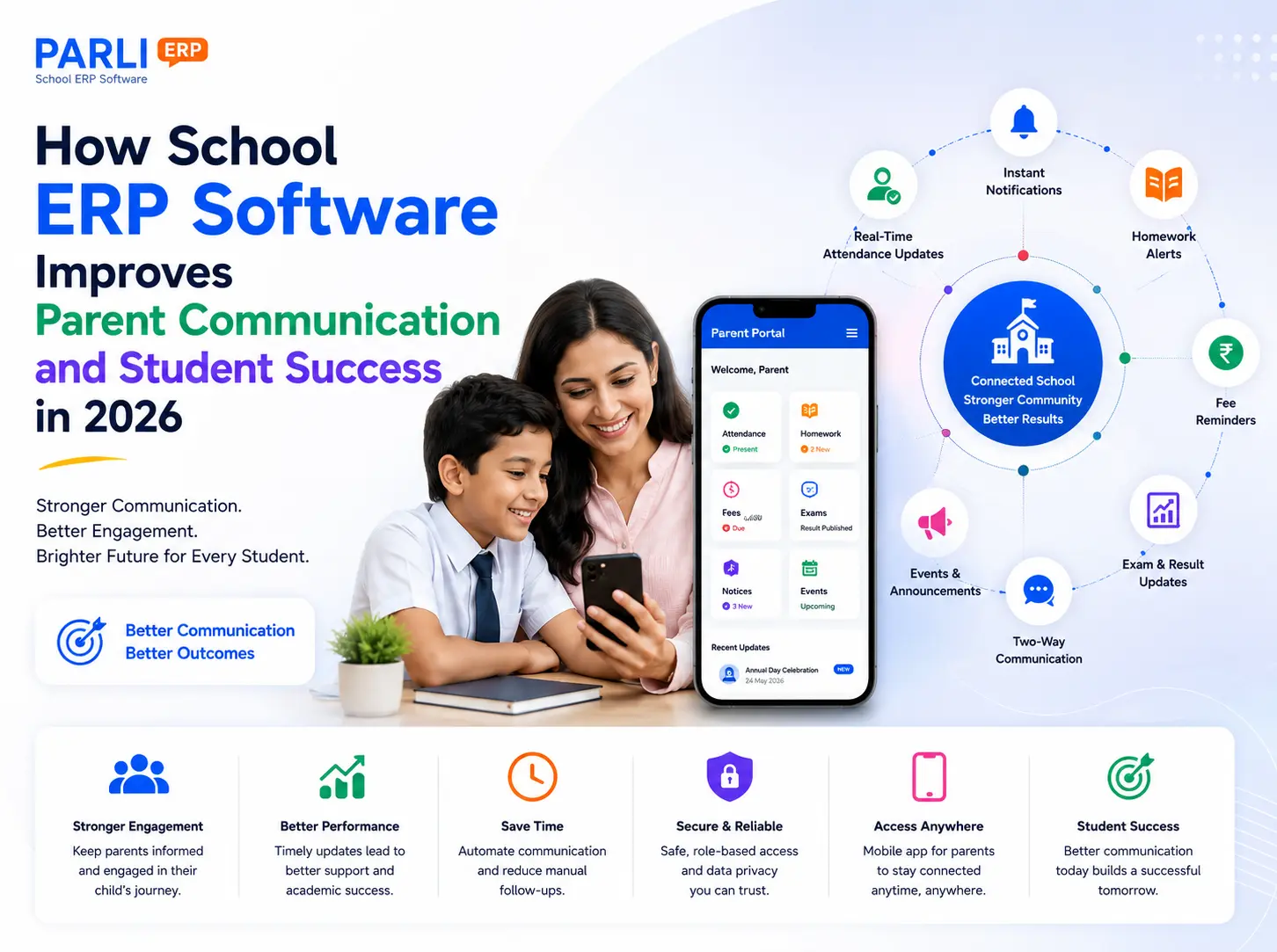
Parent-School Communication
Strong communication builds trust and improves student outcomes.
A School ERP allows schools to share:
- Notices
- Circulars
- Announcements
- Event reminders
- Important updates
Timely communication keeps parents informed and engaged throughout the academic year.
Digital Homework & Classwork Management
Teachers can assign homework and classwork digitally, making it easier for students and parents to stay updated.
Benefits include:
- Submission monitoring
- Centralized academic records
- Better classroom coordination
- Assignment tracking
This improves accountability and supports continuous learning.
Examination & Report Card Management
Preparing examination schedules and report cards manually can be time-consuming.
A School ERP simplifies this process by enabling schools to:
- Schedule examinations
- Record marks
- Generate report cards
- Publish results efficiently
Automation reduces workload and minimizes errors.
Real-Time Reports & Analytics
Data-driven decision-making is essential for modern schools.
A School ERP provides instant access to reports such as:
- Attendance summaries
- Fee collection reports
- Admission statistics
- Academic performance reports
These insights help school leaders make informed decisions.
Role-Based Security & Data Protection
Schools manage sensitive information that must be protected.
Modern School ERP solutions include:
- Role-based access
- Secure login systems
- Data backups
- Cloud storage
- User activity tracking
This ensures information remains secure and accessible only to authorized users.
Key Features Every School ERP Should Include
When selecting a School ERP, ensure it offers:
- Student Information Management
- Admission Management
- Attendance Management
- Fee Management
- Examination Management
- Homework & Classwork Management
- Parent Communication
- Notices & Circulars
- Reports & Analytics
- Mobile Accessibility
- Role-Based User Access
- Cloud-Based Data Storage
Choosing a feature-rich ERP ensures long-term value and scalability.
How a School ERP Benefits Different Users
For School Administrators
- Mobile accessibility
- Better reporting
- Improved resource management
- Faster decision-making
For Teachers
- Reduced paperwork
- Digital assignment management
- Easy attendance marking
For Parents
- Instant school updates
- Fee information
- Attendance tracking
For Students
- Homework access
- Academic updates
- Examination schedules
- Better learning experience
As expectations continue to evolve, schools that embrace digital communication tools will be better positioned to build strong partnerships with families.
Signs Your School Needs a School ERP
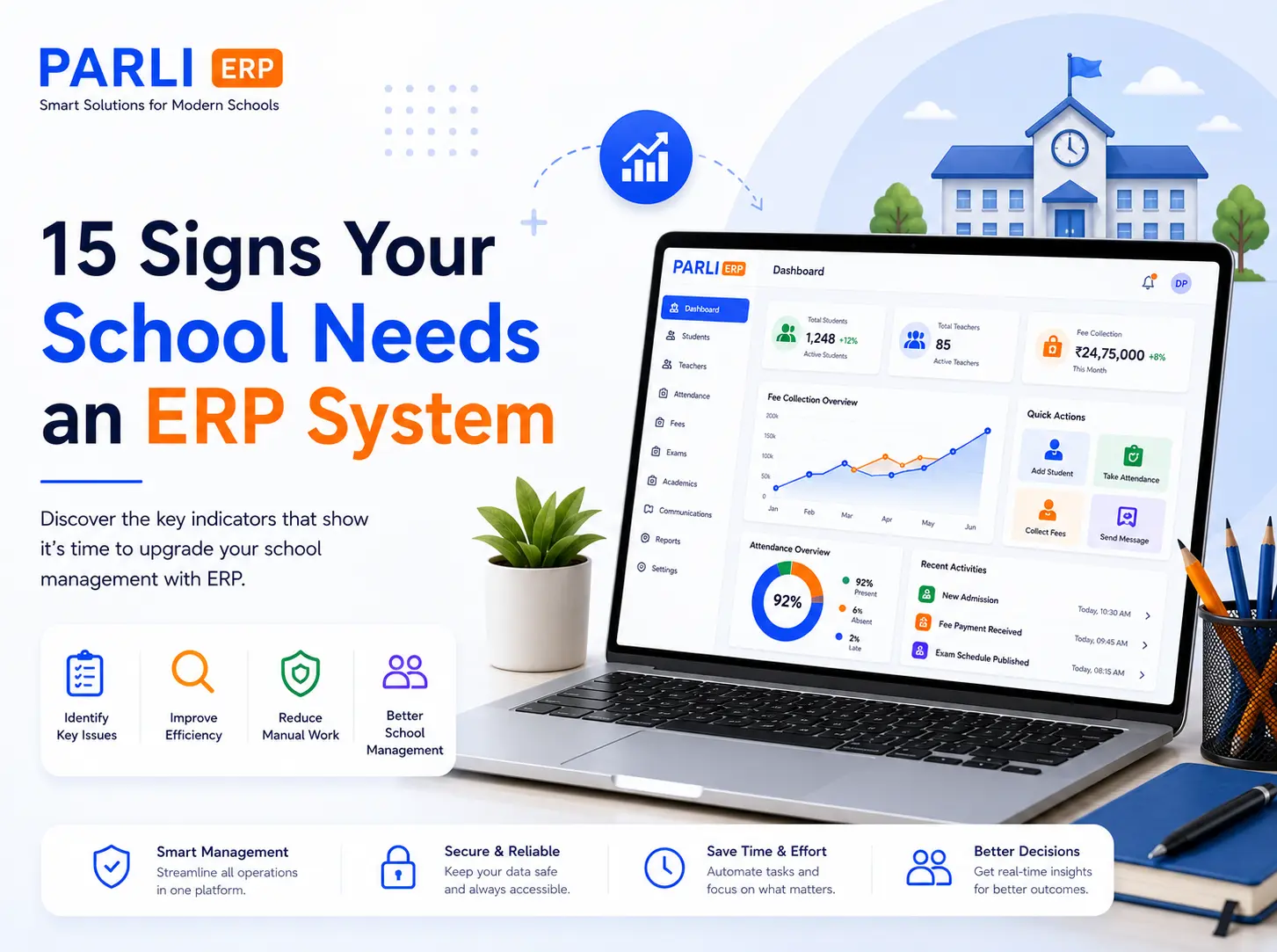
If your school experiences any of the following challenges, it may be time to implement a School ERP:
- Attendance is managed using Excel sheets.
- Fee records are difficult to maintain.
- Parent communication is inconsistent.
- Student records are scattered across departments.
- Report generation takes too much time.
- Administrative staff are overwhelmed with paperwork.
- School operations are becoming difficult to manage as enrollment grows.
These signs indicate that manual systems are limiting your school’s efficiency.
Best Practices for Choosing the Right School ERP
Before selecting a solution, consider the following:
- Choose software with an intuitive interface.
- Ensure it supports your school's current and future needs.
- Look for cloud-based accessibility.
- Prioritize data security and regular backups.
- Check mobile compatibility for teachers and parents.
- Evaluate customer support and training services.
- Compare reporting and analytics capabilities.
Selecting the right platform is a long-term investment that can significantly improve operational efficiency.
Conclusion
A School ERP is no longer just an optional technology upgrade—it’s a strategic investment for schools that want to improve efficiency, enhance communication, and deliver a better educational experience.
By automating routine tasks, centralizing data, and connecting administrators, teachers, students, and parents through a single platform, School ERP software helps institutions save time, reduce errors, and focus on what truly matters: delivering quality education.
As education continues to evolve in 2026, schools that adopt modern School Management Software and Education ERP solutions will be better equipped to meet growing expectations, embrace digital innovation, and achieve long-term success. Whether you’re managing a small private school or a large educational institution, investing in a Digital School ecosystem powered by a School ERP is one of the smartest decisions you can make.
Ready to simplify school management?
See how PARLI school ERP software helps schools automate attendance, fees, homework, and parent communication from one platform.