AI in Schools: 8 Practical Ways Artificial Intelligence Is Transforming Education in 2026
Artificial Intelligence (AI) is no longer a futuristic concept—it’s becoming a practical tool in classrooms and school administration around the world. From…
How AI in Education Is Shaping Smarter Schools in 2026
Artificial Intelligence (AI) is no longer a futuristic concept—it’s becoming a practical tool in classrooms and school administration around the world. From automating routine tasks to supporting personalized learning, AI is helping educational institutions improve efficiency, enhance learning experiences, and make better decisions.
Missed notices, delayed updates, and communication gaps can lead to confusion, reduced As schools continue their digital transformation, AI in Education is emerging as one of the most influential technologies driving innovation. Combined with modern EdTech solutions and school management systems, AI enables schools to create more engaging, efficient, and student-centered learning environments.parent engagement, and missed opportunities to support student success.
In this guide, we’ll explore eight practical ways Artificial Intelligence for Schools is transforming education and why schools should prepare for an AI-powered future.
What Is AI in Education?
AI in Education refers to the use of artificial intelligence technologies to improve teaching, learning, school administration, and student support.
AI systems can analyze large amounts of data, recognize patterns, automate repetitive tasks, and provide intelligent recommendations that help educators make informed decisions.
Rather than replacing teachers, AI acts as a powerful assistant that saves time and enhances educational outcomes.
Why Schools Are Adopting AI
Modern schools face several challenges, including:
 Increasing administrative workload
- Diverse student learning needs
- Large amounts of academic data
- Growing expectations from parents
- Limited teacher time
Artificial Intelligence helps address these challenges by improving efficiency, accuracy, and decision-making across the institution.
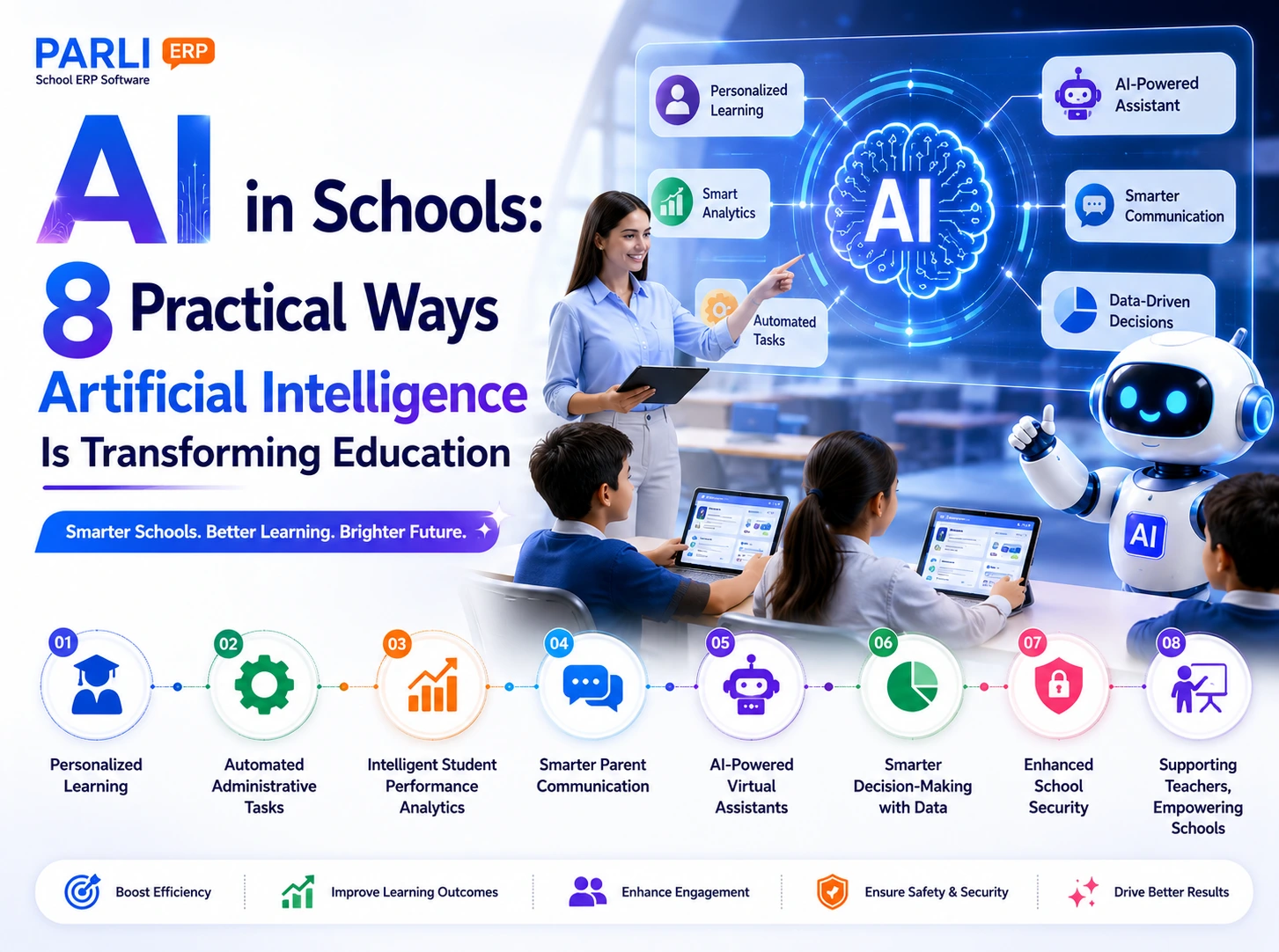
Personalized Learning for Every Student
Every student learns at a different pace. Traditional classrooms often struggle to provide individualized support for every learner.
AI-powered learning platforms can:
- Recommend personalized learning paths
- Adjust content based on performance
- Identify learning gaps
- Suggest additional practice materials
This allows students to learn more effectively while helping teachers provide targeted support.
Benefits
- Better learning outcomes
- Increased student engagement
- Individualized instruction
- Improved academic confidence
Automating Administrative Tasks
School administrators spend a significant amount of time on repetitive tasks such as attendance tracking, report preparation, and data management.
AI can automate many routine activities, including:
- Attendance analysis
- Data entry
- Report generation
- Document organization
- Administrative workflows
When integrated with a School ERP, AI further improves operational efficiency by reducing manual work and minimizing errors.
Intelligent Student Performance Analysis
AI systems can analyze student performance data more quickly than traditional methods.
They help schools identify:
- Academic strengths
- Learning difficulties
- Attendance patterns
- Performance trends
- Students needing additional support
Early insights allow teachers to intervene before small challenges become major academic problems.
Smarter Parent Communication
Strong communication between schools and parents contributes to student success.
AI-powered communication tools can assist schools by:
- Sending automated reminders
- Delivering attendance notifications
- Sharing academic updates
- Answering common parent questions through chatbots
- Scheduling important announcements
This improves responsiveness while reducing administrative workload.
AI-Powered Virtual Assistants
Many educational institutions are introducing AI assistants to support students, parents, and staff.
Virtual assistants can help answer questions about:
- Admission procedures
- School timings
- Examination schedules
- Fee information
- Event details
- Frequently asked questions
Providing instant responses improves the user experience and saves valuable staff time.
Smarter Decision-Making with Data Analytics
Schools collect large amounts of information every day.
AI-powered analytics help administrators make informed decisions by analyzing:
- Student enrollment trends
- Attendance reports
- Academic performance
- Resource utilization
- Financial data
These insights support better planning and long-term institutional growth.
Enhanced School Security
Artificial Intelligence can contribute to safer school environments through intelligent monitoring systems.
Potential applications include:
- Visitor management
- Smart surveillance alerts
- Access control monitoring
- Emergency response support
- Security analytics
While human oversight remains essential, AI can improve response times and enhance campus safety.
Supporting Teachers Instead of Replacing Them
One of the biggest misconceptions about AI is that it will replace teachers.
In reality, AI is designed to assist educators by handling repetitive administrative tasks and providing valuable insights.
Teachers can use AI to:
- Create lesson plans more efficiently
- Analyze student performance
- Generate quizzes and practice questions
- Organize classroom resources
- Save time on routine administrative work
This allows educators to spend more time teaching, mentoring, and inspiring students.
Benefits of AI in Education
Schools adopting AI technologies often experience significant improvements.
Improved Learning Experiences
Students receive more personalized educational support.
Greater Administrative Efficiency
Automation reduces repetitive manual work.
Better Student Engagement
Interactive and adaptive learning tools encourage participation.
Data-Driven Decisions
Administrators gain valuable insights through advanced analytics.
Stronger Parent Engagement
AI-powered communication improves transparency and responsiveness.
Increased Productivity
Teachers and administrators spend more time on meaningful educational activities.
Common Myths About AI in Schools
Myth 1: AI Will Replace Teachers
Reality: AI supports teachers by automating repetitive tasks and providing helpful insights.
Myth 2: AI Is Only for Large Schools
Reality: Schools of all sizes can benefit from AI-powered tools.
Myth 3: AI Is Too Complicated
Reality: Modern EdTech solutions are designed with user-friendly interfaces that make adoption easier.
Myth 4: AI Eliminates Human Interaction
Myth 4: AI Eliminates Human Interaction
How Schools Can Prepare for AI Adoption
Schools planning to implement AI should consider the following:
- Strengthen digital infrastructure.
- Train teachers and administrative staff.
- Invest in modern School ERP systems.
- Protect student data with strong security measures.
- Introduce AI gradually through practical use cases.
- Evaluate technology based on educational goals.
A thoughtful implementation strategy ensures successful adoption.
The Future of Smart Education
As technology continues to evolve, AI will play an increasingly important role in education.
Future developments may include:
- More advanced personalized learning
- Predictive student success analysis
- Intelligent classroom management
- Enhanced accessibility tools
- Improved collaboration between schools and families
- Smarter administrative automation
The schools that embrace Smart Education today will be better prepared to meet tomorrow’s educational challenges.
Conclusion
Artificial Intelligence is transforming education by making schools more efficient, connected, and student-focused. From personalized learning and automated administration to intelligent analytics and improved parent communication, AI in Education offers practical benefits for institutions of every size.
Rather than replacing educators, Artificial Intelligence for Schools empowers teachers and administrators to work more effectively while improving the overall learning experience. Combined with modern EdTech solutions and digital school management systems, AI is helping build smarter, more innovative schools.
As education continues to evolve in 2026 and beyond, schools that embrace AI responsibly will be better positioned to deliver high-quality learning, improve operational efficiency, and prepare students for a technology-driven future.
Ready to simplify school management?
See how PARLI school ERP software helps schools automate attendance, fees, homework, and parent communication from one platform.